


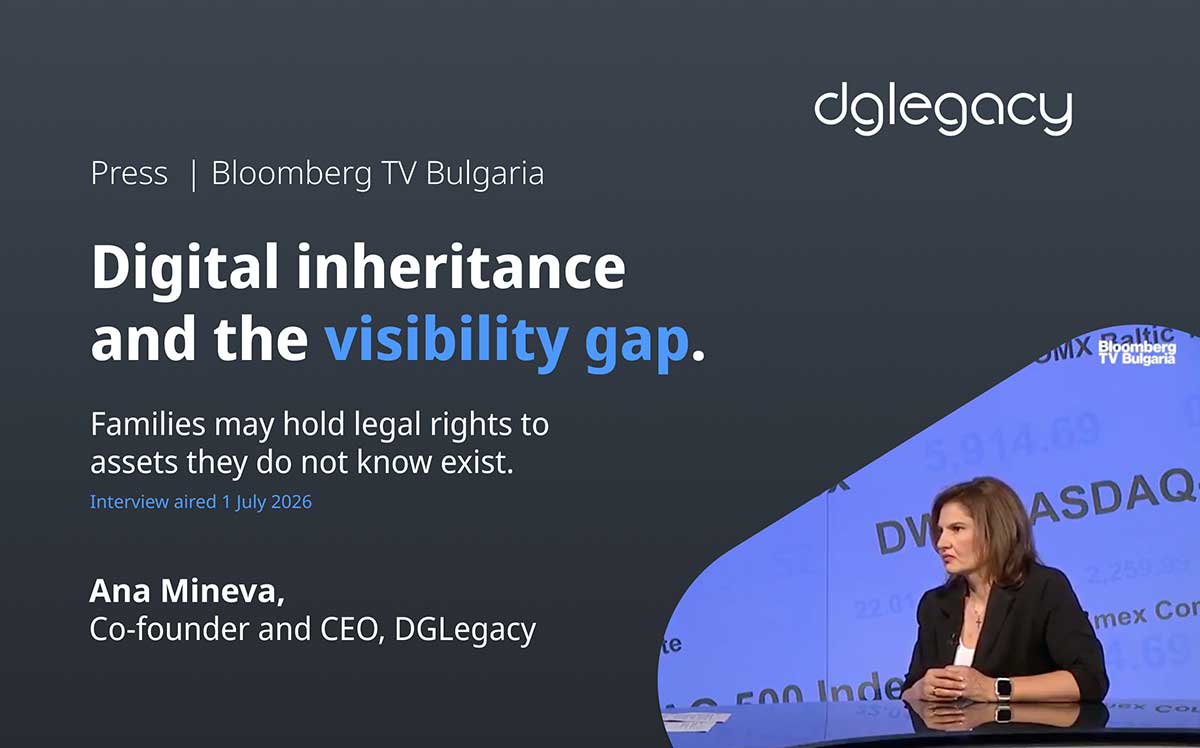
What you need to knowDGLegacy co-founder and CEO Ana Mineva spoke with Bloomberg TV Bulgaria on 1 July 2026 about a problem sitting underneath modern estate planning: families may hold legal rights to assets they do not know exist.
The next estate planning gap is not only legal. It is informational. A will can establish who should receive an asset, but it cannot tell anyone the asset is there DGLegacy defines the invisible asset problem as the risk that heirs or beneficiaries cannot locate, claim, or access assets because they do not know those assets exist. It may include investment accounts, cryptocurrency, fintech apps, domains, online businesses, cloud-stored records and other digitally managed assets.
As financial and personal assets move online, families face an increasingly practical inheritance problem: they may have legal rights to assets they do not know exist.
DGLegacy co-founder and CEO Ana Mineva recently spoke with Bloomberg TV Bulgaria about this challenge and the role of digital legacy planning in the digital assets age.
The interview aired on 1 July 2026 on The World Is Business (Светът е бизнес), Bloomberg TV Bulgaria’s programme covering economics, investment, business and global markets. In conversation with host Doriana Rankova, Mineva discussed digital inheritance, crypto assets, estate planning, security awareness, and the practical difficulties families encounter when financial information is distributed across online platforms.
Watch the full interview and read the original Bulgarian article on Bloomberg TV Bulgaria.
Why digital inheritance matters now
Investment accounts, fintech applications, crypto wallets, insurance portals, pension accounts, cloud documents, domains and online businesses do not leave the same physical trail as traditional property.
A family may be able to find a house, a vehicle, or a folder of paper documents. An online investment account or digital wallet can remain completely invisible unless someone has deliberately created a record of its existence.
This creates an inheritance visibility gap. Traditional estate planning can establish who should receive an asset, but another question comes first:
The Bloomberg TV Bulgaria interview brings attention to this at a time when more people are building wealth through digital and financial platforms. It also reflects a growing recognition that modern estate planning must account for more than legal ownership – it must account for asset awareness, current information, and family financial continuity.
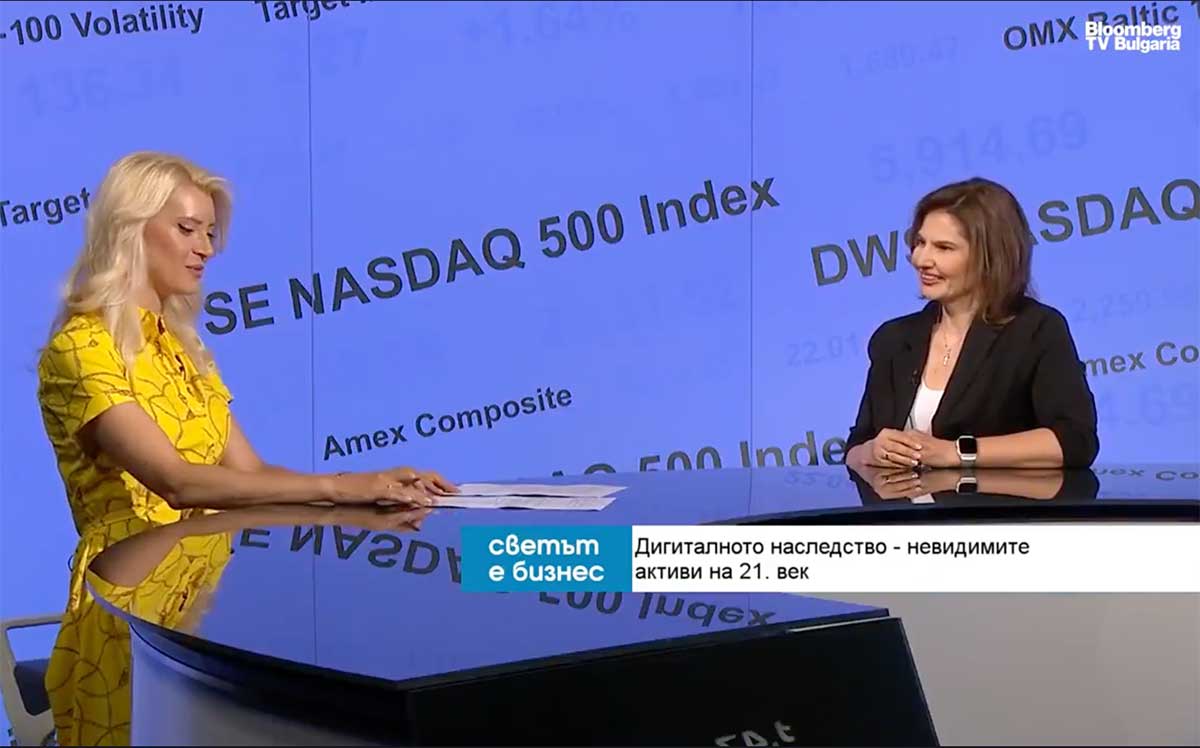
Picture source: Screenshot from Ana Mineva’s interview on Bloomberg TV Bulgaria, “The World Is Business,” 1 July 2026.
Key insights from Ana Mineva’s interview
1. Asset awareness comes before asset transfer
One of the clearest messages from the discussion was that an asset cannot realistically be inherited when the intended recipient does not know it exists.
This is not only a cryptocurrency problem. The same visibility gap affects investment accounts, insurance policies, business interests, online payment services, pension products, digital documents and other assets managed through online systems. Wherever an asset lives behind a login rather than in a drawer, its existence depends on someone having written it down. That is the invisible asset problem in its most ordinary form – nothing hidden, nothing illegitimate, simply unrecorded.
For families, the first practical step is therefore not necessarily transferring an asset. It is creating enough transparency and awareness for loved ones to identify what exists and understand what actions may be required.
Key Insight
„В днешно време най-големият проблем е да знаем, че цифровите активи съществуват и как да имаме достъп до тях.”
“Today, the biggest problem is knowing that digital assets exist and how to access them.”
Ana Mineva
Co-founder and CEO, DGLegacy® – Bloomberg TV Bulgaria, 1 July 2026. Translated from Bulgarian.
2. Digital legacy planning complements legal estate planning
The interview highlighted an important distinction between legal entitlement and practical visibility.
A will, trust or other estate-planning document establishes who has the right to receive or manage an asset. What it does not do is maintain a continuously updated view of every financial account, digital asset or online service a person uses. Legal instruments carry authority. They do not carry information, and without the information, the authority has nothing to reach for.
Mineva described digital legacy planning as a way to organise information about physical, financial and digital assets and associate designated beneficiaries with them, so the appropriate people become aware of the relevant assets when that information is needed.
This is not a replacement for a lawyer, a will, a trust, or professional financial guidance. It is a complementary, practical layer addressing the informational gap around modern assets.
The interview referenced DGLegacy’s work with Future Proof Plans, a U.S.-based estate-planning platform whose document templates are prepared and reviewed by attorneys at Saxton Law. The collaboration illustrates how legal documentation and current asset visibility support different, but connected, parts of the planning process. DGLegacy itself is a technology platform and does not provide legal advice.
3. Crypto inheritance involves more than private keys
Cryptocurrency makes the visibility gap especially clear.
An heir may have a legal claim to a crypto asset, but that right alone does not reveal that the asset exists, which wallet or exchange is involved, or what legitimate process should be followed next.
During the discussion, Mineva used the idea of a digital equivalent to a house key. In the physical world, an heir generally knows the property exists and where it is located. In the digital world, both the asset and the route to it may be invisible.
Responsible crypto inheritance planning therefore requires more than recording confidential credentials. It involves documenting the existence and nature of the asset, identifying the appropriate beneficiary, and leaving clear guidance without creating unnecessary security exposure.
4. Trust depends on what is actually being monitored
People are understandably cautious about organizing sensitive financial and personal information online. For any digital legacy service, trust cannot depend on broad promises or promotional claims. It depends on what the service actually does.
Asked about DGLegacy’s monitoring of 700+ of the top global financial companies, Mineva described it as an additional layer of protection for users’ assets. The platform, Mineva said, tracks signals of security breaches or threats to the financial institutions where users hold their money, so that those users can be notified.
On the platform this runs on two separate fronts: cybersecurity breaches, and media alerts regarding a company’s financial stability. An institution can be well defended and still be financially unstable. If either surfaces at a company holding one of the assets a user has catalogued in the app, DGLegacy proactively notifies the user.
What is monitored is the institutions, not the users. That distinction matters. Digital legacy readiness is not one product feature – it combines the technology, the owner’s own decisions about what to record and who should be told, and professional legal or financial support where the situation calls for it.
5. Wealth crosses borders. Inheritance law does not.
DGLegacy is headquartered in Germany, with most of its team based in Bulgaria – what Bloomberg TV Bulgaria called the company’s “Bulgarian DNA.” It operates as a global service, to help more people around the world protect what matters most, especially in the age of digital assets, where most of the assets are invisible: you can’t see them or touch them.
People increasingly hold wealth through international banks, investment platforms, digital wallets, employer equity programs, insurance providers and online businesses. A single family’s assets may sit across several countries and a dozen services, while the people who will one day need to find them have little or no visibility into any of it.
Inheritance rules remain jurisdiction-specific. The practical questions remain the same:
- What assets exist?
- Where are they held?
- Who should know about them?
- What will loved ones need in order to take the appropriate next step?
This is also the reason DGLegacy is not a law firm. A lawyer is licensed in one jurisdiction; an estate plan is written under one country’s law. Neither travels with assets held in five. The information does: what exists, where it is held, and how to begin, which is what allows the service to work alongside legal planning in any country.
Growing recognition of the digital estate planning gap
The media appearance follows broader international recognition of DGLegacy’s work. In 2024, the company was selected as one of the Startup Battlefield Top 20 finalists at TechCrunch Disrupt, where it presented its approach to digital legacy planning and inheritance. TechCrunch states that less than 1% of applicants to the Startup Battlefield programme are selected as Top 20 finalists.
The Bloomberg TV Bulgaria interview adds another dimension to that visibility by focusing less on startup recognition and more on the underlying family and financial problem.
The discussion carried beyond the broadcast itself: Investor.bg, one of Bulgaria’s main financial news outlets, reported on the interview the following day.
The same argument reached a different audience earlier the same summer: Bulgarian legal portal Lex.bg published Mineva’s expert contribution on inheritance visibility in June 2026, addressed to legal professionals rather than a business-television audience.
Digital legacy planning begins with visibility
The central lesson from the interview is practical: families cannot locate, claim, or access assets they do not know exist.
Creating an organised and current record of financial, physical and digital assets reduces uncertainty for loved ones. Combined with appropriate estate-planning documents and professional advice, this visibility supports a more complete approach to digital inheritance and family financial continuity.
The Bloomberg TV Bulgaria feature introduces several additional parts of the conversation, including DGLegacy’s development, partnerships, use of technology, and plans for the future.
CATALOGUE YOUR FIRST ASSET
Protect your loved ones when it matters the most
Frequently asked questions
What is digital inheritance?
Does a will cover digital assets and cryptocurrency?
What happens to cryptocurrency when the owner dies?
Is digital legacy planning a replacement for a will or a lawyer?
Educational. Not legal, tax or financial advice.
This article summarises a TV interview aired on Bloomberg TV Bulgaria (1 July 2026) discussing digital inheritance and estate planning in a Bulgarian and international context. Inheritance rules differ by jurisdiction and change over time. For advice on a specific estate, consult a qualified professional in the relevant jurisdiction.