

Originally published in Bulgarian on Lex.bg, 29 June 2026. Summary prepared by the DGLegacy Press Team.
What you need to knowModern estates increasingly consist of invisible assets – online broker accounts, crypto-asset wallets, fintech balances and workplace benefits that leave few visible traces.
A will decides who inherits; it rarely records what exists or where.
Families cannot locate, claim, or access assets they do not know exist. DGLegacy calls this the invisible asset problem. It creates an inheritance visibility gap between legal entitlement and practical discoverability.
As more wealth moves online, families face a question traditional documents alone may not answer: will loved ones know enough to locate, claim, or access the assets they are entitled to?
DGLegacy co-founder and CEO Ana Mineva has published a new expert article on Lex.bg, one of Bulgaria’s most established and comprehensive legal information portals. Published on June 29, 2026, the Bulgarian-language article is titled „Невидимото наследство” / “The Invisible Inheritance”, with the subtitle “Digital Assets, Digital Identity, and the Changing Meaning of Inheritance.”
The publication draws greater attention to a practical challenge that is becoming increasingly important in the age of digital assets: the difference between having a legal right to inherit an asset and knowing that the asset exists in the first place.

Bringing digital inheritance into Bulgaria’s legal conversation
Lex.bg (ISSN 2682-9606) is widely used by Bulgaria’s legal and professional community as a source of legal news, legislation, case law, commentary, and professional information.
The publication of Mineva’s article on the platform creates an important opportunity to introduce questions of digital inheritance, crypto inheritance, inheritance visibility, and digital asset estate planning into the broader Bulgarian legal discussion.
The article is an expert contribution written by Mineva and published by Lex.bg. It is not an interview, an independent assessment of DGLegacy, or an endorsement of the company’s services.
Instead, it presents a founder-led examination of an emerging problem at the intersection of inheritance law, technology, financial planning, and family continuity.
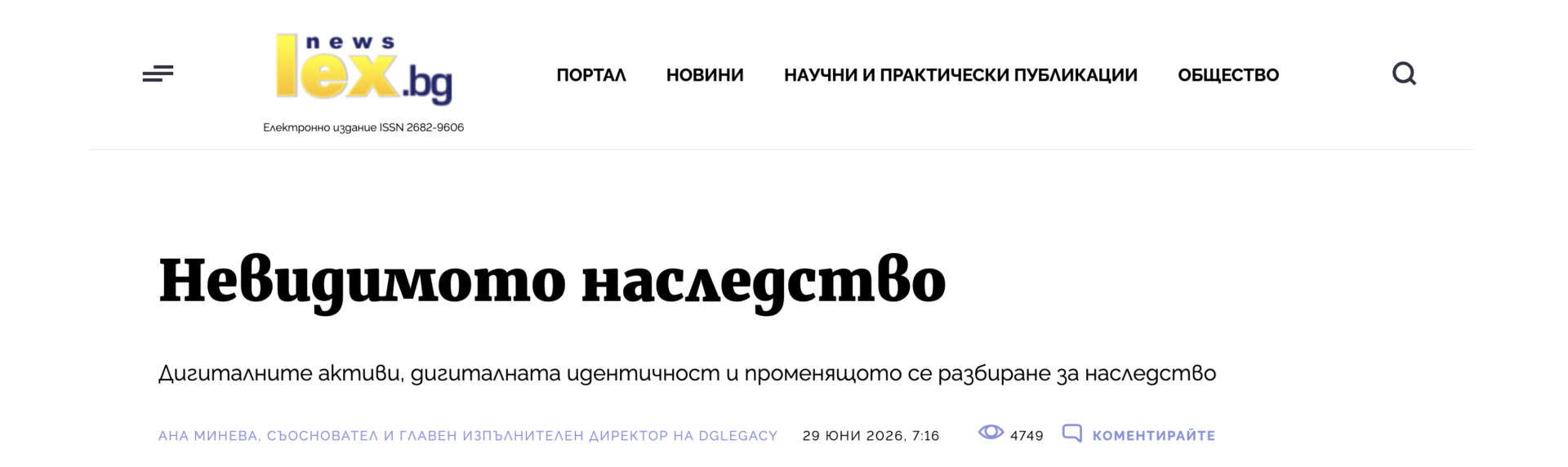
Picture source: Screenshot from Lex.bg, “Невидимото наследство,” 29 June 2026.
Why the “invisible inheritance” matters now
Inheritance planning has traditionally focused on questions such as who inherits, what share each person receives, and which legal instruments are required.
Those questions remain essential. However, the way people hold wealth has changed.
A person’s assets may now include:
- investment accounts held through international online brokers;
- crypto-assets stored in exchange accounts or hardware wallets;
- funds held with fintech and payment platforms;
- insurance policies and pension benefits;
- shares in foreign companies or startups;
- revenue from online businesses, royalties, and digital services;
- digital wallets, online identities, documents, and important account information.
Unlike a house, vehicle, or account at a familiar local bank, many of these assets may leave few visible clues for family members.
Source-backed claim
This shift is not limited to Bulgaria. The European Central Bank’s Study on the Payment Attitudes of Consumers in the Euro Area (SPACE) 2024 found that the share of euro area respondents owning crypto-assets more than doubled, from 4% in 2022 to 9% in 2024. As digital and cross-border asset ownership grows, so does the importance of planning for asset awareness and continuity.
Source: ECB — SPACE 2024, section 4.2.3. Figures describe survey respondents, not the general adult population.
Five central ideas explored in the article
1. The next estate-planning gap may be informational
The article’s central argument is that the next major inheritance risk is not exclusively legal.
A will or another legal instrument may establish who should receive an estate. It does not necessarily provide a complete and current picture of what the estate contains, where each asset is located, or which institution should be contacted. This is the problem of invisible assets.
As Mineva writes, translated from Bulgarian:
„Семейството не може да наследи, заяви, защити или достъпи актив, за чието съществуване никога не е знаело.”
“A family cannot inherit, claim, protect, or access an asset it never knew existed.”
Ana Mineva, CEO DGLegacy®
writing in Lex.bg · English translation by DGLegacy
This is the inheritance visibility gap: legal arrangements may be in place, while essential information about the assets remains unavailable to the people who will eventually need it.
2. Legal ownership and practical access are not always the same
A digital asset may be legally inheritable but difficult — or sometimes impossible — to access without the necessary information.
Passwords, two-factor authentication, private keys, seed phrases, mobile devices, and platform-specific procedures can separate legal entitlement from practical control.
“The court may say the deceased’s crypto belongs to the heir. The platform, however, says: ‘Give me the key.'”
„Съдът може да каже, че криптото на наследодателя остава за наследника. Платформата обаче казва: „Дай ми ключа.““
Ana Mineva
writing in Lex.bg · English translation by DGLegacy
The article does not argue that access credentials should simply be placed in a will or shared without appropriate security safeguards. Instead, it highlights the need for structured planning so that designated people know what exists, where to look, and what process to follow.
3. Modern estates increasingly cross national and institutional borders
The article uses the example of a Bulgarian citizen who may live in one country, work for a company in another, invest through a European online broker, and hold crypto-assets independently. The same pattern appears with physical assets — the records behind an inherited home can be just as hard to reconstruct.
This pattern is relevant far beyond Bulgaria. International families, expatriates, remote workers, founders, investors, and globally mobile professionals often accumulate assets across multiple jurisdictions and platforms.
The EU Succession Regulation (650/2012) can help establish which national law applies, and the European Certificate of Succession can demonstrate a person’s status as an heir. Neither automatically provides a complete inventory of a deceased person’s foreign brokerage accounts, fintech balances, crypto wallets, or other undisclosed digital holdings.
4. Existing systems identify only part of the financial picture
Mineva explains that Bulgaria has real mechanisms for tracing traditional financial relationships. Heirs can request a search of the Register of Bank Accounts and Safe Deposit Boxes maintained by the Bulgarian National Bank, and establish which banks held accounts or a safe deposit box — even where the deceased never shared that information during their lifetime.
What matters just as much is what the system does not show. The register covers institutions licensed in Bulgaria. It does not see foreign fintech applications, investment accounts with international brokers, digital wallets, or crypto-asset exchanges.
This Bulgaria-specific example illustrates a wider international issue: national registers and established inheritance processes were generally developed for assets held within identifiable domestic institutions. Modern financial lives are increasingly distributed across systems that may not be visible through any single search or authority.
5. Digital asset inventories should complement professional planning
The article positions digital asset inventory and inheritance visibility as a practical layer that complements traditional estate planning.
Wills, trusts, notarial instruments, professional legal advice, financial planning, and regulatory frameworks remain essential. Digital legacy planning does not replace them.
Its role is different: to help create structured asset awareness so that loved ones and professional advisers can understand what exists, where relevant information can be found, and which next steps may be required.
This distinction is particularly important for lawyers, estate planners, financial advisers, insurers, wealth managers, employers, and benefits providers. Their work may be legally and financially sound, but family continuity can still break down when essential assets or benefits remain unknown.
Why the topic extends beyond the Bulgarian market
Although the original article examines specific aspects of Bulgarian and European law, its main question is international:
Can a family inherit an increasingly digital and cross-border financial life if no one has a clear view of it?
The same challenge appears when:
- an investor uses several international brokerage platforms;
- a crypto-asset owner keeps holdings in both custodial and self-custody wallets;
- an employee has equity, insurance, or pension benefits that family members do not know about;
- an entrepreneur receives income through online services or foreign companies;
- an expatriate family must navigate institutions in several countries;
- important accounts and instructions exist only inside personal devices or cloud services.
In each case, the legal right to an asset is only one part of family financial continuity. Awareness, discoverability, documentation, and an appropriate access process also matter.
Contributing to a more complete understanding of modern inheritance
Through its publication on Lex.bg, Mineva’s article brings the issue of invisible assets to the attention of Bulgaria’s legal and professional community while contributing to a wider conversation about estate planning in the digital assets age.
The article also reflects the principle behind DGLegacy: families cannot locate, claim, or access assets they do not know exist.
DGLegacy is a digital legacy planning and inheritance app designed to help people organize information about their financial, digital, and physical assets, designate beneficiaries, and create greater transparency and awareness for loved ones. It is intended to complement legal, financial and estate-planning processes with a practical visibility layer, giving transparency and awareness to loved ones so they can locate, claim and access their designated assets — not to replace professional advice or established legal instruments.
Read the original Bulgarian article on Lex.bg
Readers who work in law, financial planning, wealth management, insurance, human resources, digital assets, or family financial preparedness can explore the full argument and its Bulgarian and European legal context in the original publication.
Read „Невидимото наследство” by Ana Mineva on Lex.bg.
How DGLegacy addresses the Invisible Asset Problem
DGLegacy complements wills, trusts, beneficiary designations, professional estate planning, and secure credential-management tools. It does not replace them. This way DGLegacy gives transparency and awareness for your loved ones, so they can easily locate, claim and access their designated assets.
Frequently asked questions
Can a family inherit an asset they do not know exists?
Legally, yes. Practically, often no. An heir’s entitlement does not depend on their awareness. But families cannot locate, claim, or access assets they do not know exist. If no one knows an account, wallet, or policy exists, there may be no obvious institution to contact or claim to initiate. This is the inheritance visibility gap: the legal right may be intact while the information needed to act on it is missing.
Is a will enough to cover digital and crypto-assets?
A will establishes who should receive an estate. It does not usually record what the estate contains, where each asset is held, or which platform to contact. For digital and crypto-asset holdings that gap matters more, because there may be no statement, branch or local institution to reveal them. Legal instruments and an asset inventory answer different questions and work best together.
Do national financial registers reveal foreign crypto and fintech accounts?
Not necessarily. National registers were generally built for assets held with identifiable domestic institutions. Accounts with foreign fintech providers, international brokers, crypto-asset exchanges or self-custody wallets may fall outside any single national search. Heirs can hold valid legal status and still have no mechanism that reveals the full picture of a cross-border digital estate.
Does digital legacy planning replace a lawyer or a will?
No. Wills, trusts, notarial instruments and professional legal advice remain essential, and digital legacy planning does not substitute for any of them. Its role is to add a visibility layer, so that loved ones and professional advisers can locate, claim and access what exists. The legal work stays with the professionals.
Educational. Not legal, tax or financial advice.
This article summarises a publication discussing Bulgarian and European legal context. Inheritance rules differ by jurisdiction and change over time. For advice on a specific estate, consult a qualified professional in the relevant jurisdiction.