



The house is the easy part. It’s everything attached to it that goes missing.
When you inherit a home, you can see the house. What you usually can’t see is everything wired to it: the company that services the mortgage, where the insurance policy lives, which bills are on autopay, the inbox where the tax notices land, and whether there’s a solar lease, a home warranty, or an escrow account humming along in the background.
A will tells your family who gets the house. It almost never tells them what’s attached to it, or how to reach any of it, and that’s the part where people get stuck.
Key takeaways
- The house is visible; the records attached to it usually aren’t.
- Eight records families most often can’t find: the loan servicer, the insurance policy, utility autopay, the tax-notice inbox, smart-home accounts, a solar lease/PPA, a home warranty, and linked investment/escrow accounts.
- Federal law lets most families keep an inherited mortgage and request information from the servicer, but only once they know who and what to ask about.
- The fix is informational: organize transparency and awareness before it’s needed.
When someone leaves you a house, the grief is immediate but the paperwork is patient. It waits. And then, a few weeks in, it starts arriving, or worse, it stops arriving, because the notices were going to an email address no one can open anymore.
Here’s the strange thing about an inherited home. Of all the assets a family deals with after a death, the house is the one you can actually see. You can stand in it. You have the keys.
But the house is really a hub, and spoking out from it are a dozen accounts, policies, and contracts that stay completely invisible until one of them breaks:
- A mortgage payment gets missed.
- An insurance policy quietly lapses.
- A tax notice goes unanswered because it was only ever sent to a paperless inbox.
Key InsightThe core challenge is not only the legal right to receive an asset. It is whether loved ones know the asset exists at all.
A partner may know about the house but not an online investment account; children may know about a bank account but not a crypto wallet.
Loved ones cannot claim what they do not know exists.
- Am I on the hook for this loan?
- Should I keep it, refinance, or sell?
- What happens in probate?
Those are real questions with solid answers – Redfin covers the practical side of managing a mortgage on an inherited home in detail.
This article is about the step that comes before all of that, and often blocks it: finding everything the house is connected to in the first place.
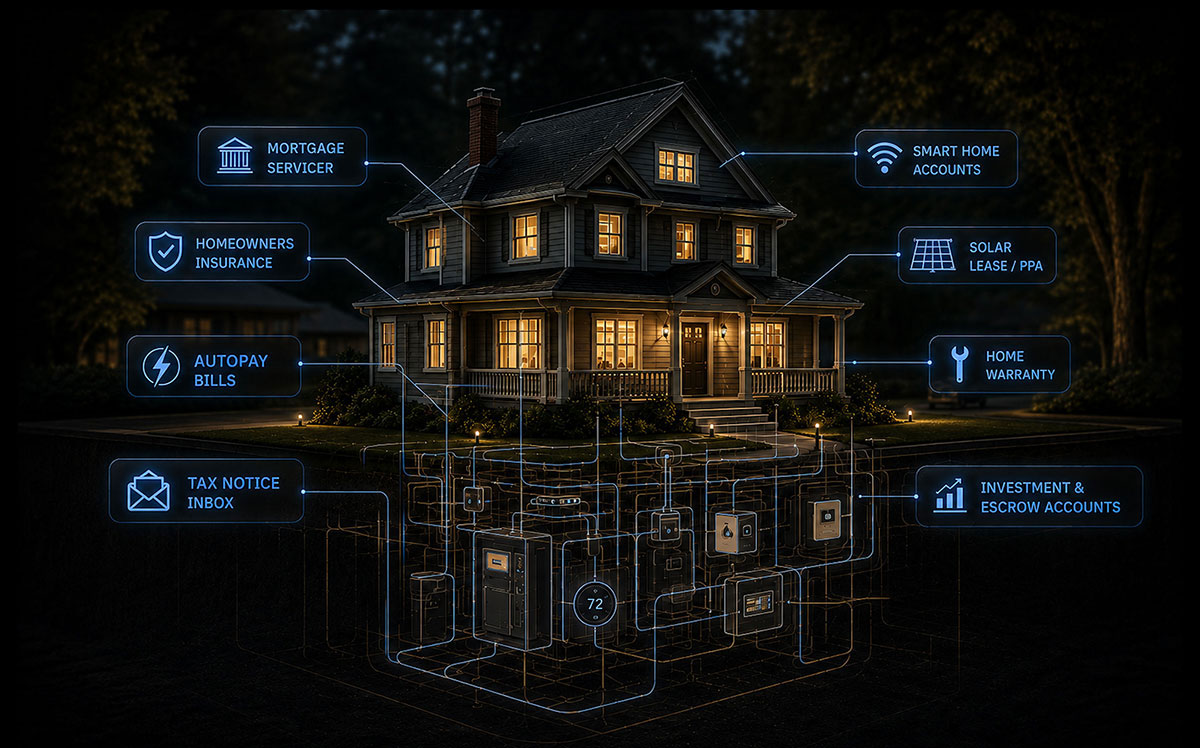
The eight things families most often can’t find
1. Who actually services the loan
The mortgage doesn’t vanish when the owner dies. It stays attached to the house and has to be paid – by the estate, by an heir, or out of the proceeds if the home is sold.
The good news is that federal law is on the family’s side here: under the Garn-St Germain Act, a relative who inherits a home generally gets to keep the existing mortgage on its original terms without requalifying.
But that protection only helps once you know who to call.
Finding the loan servicer is usually step one after a death, and it’s the step families most often can’t complete, because the statements were digital and the login is gone.
2. Where the homeowners insurance policy is
This is the one that quietly costs people the most.
Homeowners insurance doesn’t automatically carry over, and if the insurer isn’t notified, usually within about 30 days, with a death certificate, the coverage can lapse.
That leaves the single most valuable thing the family just inherited sitting completely unprotected, right in the middle of probate.
When the policy can’t be found, families end up reverse-engineering it: combing through bank statements for the premium payment, or calling the mortgage lender, who keeps a copy on file.
3. Which bills are on autopay
Autopay is convenient right up until it isn’t. After a death, it fails in two opposite directions.
Sometimes it keeps running, quietly draining an account no one’s watching. This risk is very real: we have heard stories of recurring payments continuing long after someone has died, including a case in which rent was collected automatically for nearly a year because the bank account remained active and no one knew to stop it.
Sometimes autopay stops, and the refund gets kicked back to a dead card, where it eventually becomes unclaimed property the family never knows to look for.
And transferring service isn’t a five-minute call: nearly every utility wants a certified death certificate, and setting up new accounts often means fresh deposits, commonly $100 to $300 per service.
4. Which email gets the tax notices
In a paperless household, the property tax bill, the escrow statement, the insurance renewal, they all land in one inaccessible inbox.
If that inbox belonged to the person who died, an entire layer of the home’s financial life goes dark overnight.
Nothing bounces. Nothing alerts anyone. The notices just quietly go unread until something’s overdue.
5. Whether there’s a smart-home account
Thermostats, cameras, doorbells, garage doors – modern homes come with logins.
Getting into those accounts is governed by state digital-asset laws, and there’s a real process for it. But the process is moot until the family even realizes the account exists.
You can’t request access to something you don’t know is there.
6. Whether there’s a solar lease
Rooftop solar is its own hidden layer, and it surprises people.
If the panels are on a lease or a power purchase agreement, they’re owned by the solar company, not the estate, which means the family inherits a decision:
- keep paying,
- buy the contract out,
- transfer it to a new owner, or
- cancel it (often with an early-termination fee).
And an undiscovered solar agreement can genuinely complicate selling or refinancing the home, because it’s tied to the property.
7. Whether there’s a home warranty
A home warranty is one of those recurring service contracts that tends to fail silently.
Either it lapses, and the family loses coverage right when the water heater goes, or it keeps charging month after month for a house no one’s living in yet.
Both outcomes come from the same root: nobody knew it was there.
8. Whether there are linked investment or escrow accounts
Escrow is invisible by design. It’s folded into the monthly mortgage payment, so most people never think about it as a separate account, but overpayments in it routinely resurface later as unclaimed money.
And any investment account the owner held without a named beneficiary or joint owner doesn’t pass automatically; it falls into the probate estate.
In every case, it can’t be handled if the family doesn’t know it’s there.
What the law actually says
On keeping the mortgage.
The Garn-St Germain Depository Institutions Act of 1982 (12 U.S.C. §1701j-3) generally stops a lender from enforcing a “due-on-sale” clause when a home with fewer than five units passes to a relative after the borrower dies.
The inheriting relative can keep the loan on its existing terms without requalifying.
On getting information out of the servicer.
The CFPB’s 2016 Mortgage Servicing Rule, under Regulations X and Z, includes successor-in-interest provisions that became effective on April 19, 2018.
Once a servicer confirms you as a successor in interest, it has to treat you like a borrower. This means you can request:
- The loan balance.
- A payoff statement.
- Loss-mitigation options.
You can request this information without becoming personally liable for the debt.
The CFPB wrote this rule specifically because servicers had been stonewalling grieving family members whose names weren’t on the loan.
On tax mail and finding accounts.
The IRS provides Form 56 to redirect a deceased person’s tax correspondence to whoever’s handling the estate, and Form 8822 to change the address on file.
There’s also a quietly powerful tool called the IRS Wage and Income Transcript. It lists the income documents, such as W-2s and 1099s, filed under the person’s Social Security number.
It is effectively a map of who was paying them, which can surface accounts the family didn’t know about.
Executors generally have to request these transcripts by mail with court-issued letters, not online.
On a missing life insurance policy.
The NAIC Life Insurance Policy Locator, along with state unclaimed-property programs searchable through MissingMoney.com, exists precisely because policies and payouts go unlocated all the time.
If a benefit stays unclaimed long enough, it can end up being turned over to the state.
The part no law fixes
Notice the thread running through all of it.
Every one of those protections, the right to keep the mortgage, the right to information, and the tools to redirect the mail, only works once the family knows what exists.
The law is good at deciding who has the right to something. It does nothing to make that something visible in the first place.
That’s the real gap. It isn’t legal. It’s informational. And it’s the part most estate plans leave completely unaddressed.
“Inheriting a home lands at the worst possible time to go hunting for paperwork. The most useful thing you can leave the people you love isn’t only the decision about who gets the house – it’s a clear picture of everything attached to it, so they can find it and reach it without a forensic dig through old statements and locked inboxes. A will can’t give them that clarity. Something has to.”
Ana Mineva
CEO and Co-founder of DGLegacy®
DGLegacy is a digital legacy planning and inheritance app built for the digital-assets age. It can help give your loved ones the transparency and awareness they need to locate, claim, and access the things you leave behind, including: the records, policies, accounts wired to a home, at the moment it matters most.
CATALOGUE YOUR FIRST ASSET
Protect your loved ones when it matters the most
Join the people who trust DGLegacy® and start protecting your assets now.
Frequently asked questions about inherited home records
Do I inherit the mortgage when I inherit a house?
Usually the house comes with the loan still attached, and it has to keep being paid.
Under the Garn-St Germain Act, a relative can typically keep the existing mortgage on its original terms without requalifying — but identify and contact the loan servicer first.
How do I find a homeowners insurance policy after someone dies?
Start with the home and any safe-deposit box, then check bank and card statements for the premium payment.
You can also ask the mortgage lender, as they usually keep a copy of the policy on file. Notify the insurer promptly, since coverage can lapse if it isn’t informed of the owner’s death.
What happens to utilities and autopay when a homeowner dies?
Autopay may keep running or may stop and issue refunds to a closed account.
To transfer service you'll generally need a certified death certificate, and new accounts often require deposits of roughly $100–$300 each.
Where do the tax notices go if everything was paperless?
They may continue going to the deceased owner’s email inbox, which is why they often go unread.
The IRS provides Form 56 to redirect a deceased person’s correspondence to the estate’s representative.
What do I do about rooftop solar on an inherited home?
First, check whether the solar system is owned, leased, or covered by a power purchase agreement.
With a lease or PPA, the panels belong to the solar company. You’ll need to decide whether to continue payments, buy out the agreement, transfer it, or terminate it. The agreement can also affect a future sale or refinancing of the property.