

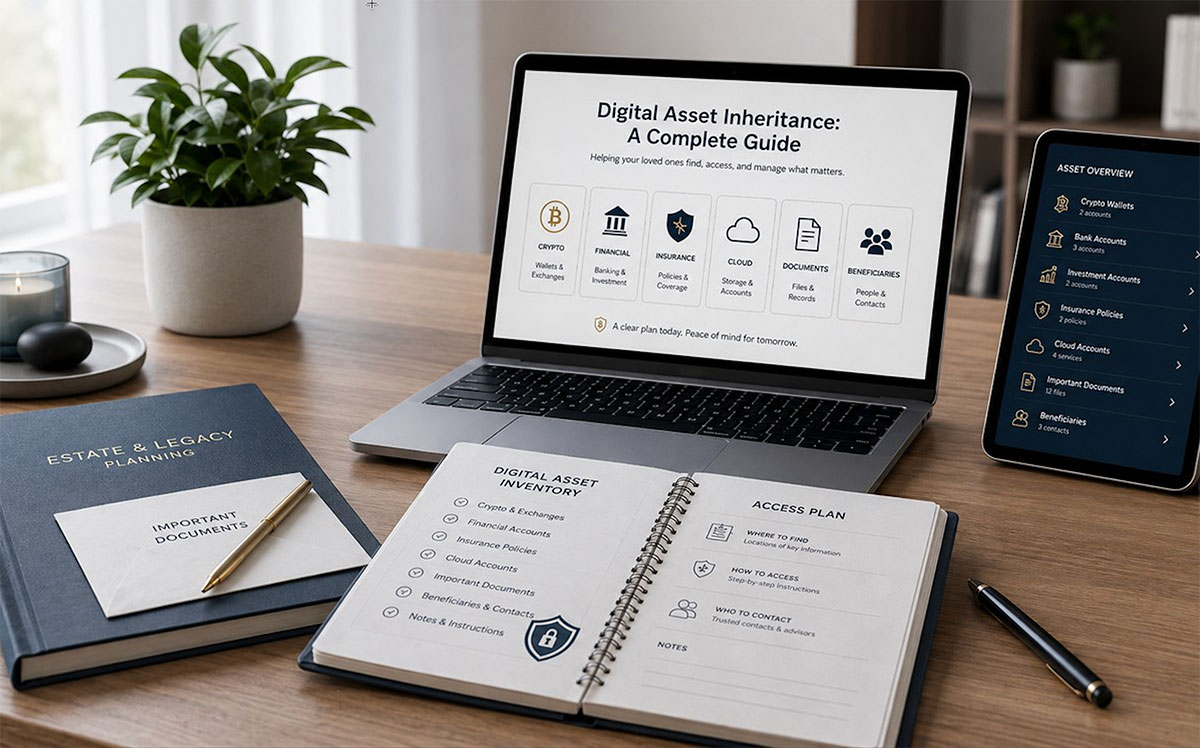
What you need to knowDigital asset inheritance is the process of identifying, locating, claiming, and transferring a person’s digital and digitally-accessed assets after they can no longer manage them, so loved ones know those assets exist and where to begin. In practice, legal authority is only one part of the process: the people who may need to act also need visibility into what exists, where it is held, and the appropriate path to locate, claim and access it.
Key takeaways
- Digital asset inheritance begins with visibility, not only ownership or legal authority.
- Digital-native assets, traditional financial assets accessed digitally, and digital records can create different inheritance challenges.
- Wills, trusts, and beneficiary designations can establish intent and authority, but they do not automatically maintain a current asset catalogue.
- Crypto inheritance involves more than private keys: awareness, custody, documentation, legal authority, tax context, and safe access can all matter.
- Effective preparation means cataloguing what exists, deciding who should be informed, keeping information current, and creating a reliable path for the right people to know where to begin.
What is digital asset inheritance?
Digital asset inheritance begins before anyone files a claim or tries to access an account.
It begins with three practical questions: What exists? Where is it held? What is the correct next step?
As financial lives have moved into apps, platforms, wallets, portals, cloud services, and online business tools, those questions have become harder for another person to answer.
DefinitionDigital asset inheritance is the process of identifying, locating, claiming, and transferring a person’s digital and digitally-accessed assets after they can no longer manage them, so loved ones know those assets exist and where to begin.
Digital asset inheritance is not a new legal category that overrides ordinary inheritance law. The legal treatment of an asset still depends on the asset, ownership structure, beneficiary designation, provider terms, applicable law, and jurisdiction.
What changes in the digital age is the information problem surrounding the asset.
For the concise entity definition and related terminology: What Is Digital Asset Inheritance?
How digital asset inheritance works
A useful way to understand digital asset inheritance is as a sequence. Legal rights matter throughout the process, but they cannot be exercised effectively if the asset itself remains invisible.
1. Identify what may exist
The first challenge is discovery. Loved ones, executors, trustees, or other authorised people need enough information to understand which financial, digital, physical, or business assets may exist.
2. Locate the provider, platform, wallet, document, or institution
Knowing that an asset exists is different from knowing where it is held. A family may know there was an investment account but not which broker held it, or know crypto existed without knowing how it was held.
3. Establish who has the right or authority to act
A beneficiary designation, will, trust, court appointment, provider procedure, or other legal mechanism may determine who can take the next step. Legal authority and practical visibility are related, but they are not the same thing.
4. Understand the provider and access process
Different assets can require different procedures. Access may depend on applicable law, provider procedures, ownership, beneficiary designations, credentials, fiduciary authority, identity verification, and jurisdiction.
5. Locate, claim and access the relevant asset
Once the asset is known, located, and the appropriate authority established, the relevant person can begin the provider, legal, administrative, or technical process required to locate, claim and access it.
6. Transfer, manage, preserve, or close the asset as appropriate
What happens next depends on the asset and the circumstances. It may eventually be transferred, retained, sold, managed, closed, or otherwise handled through the appropriate legal and provider process.
Missing information at the beginning can prevent everything that follows.
The invisible asset problem
For generations, inheritance left physical clues: filing cabinets, bank statements, property documents, insurance letters, keys, safes, and familiar advisors.
Many of those clues still exist. But a growing part of a person’s financial and business life can now sit behind a login, inside an app, in a wallet, on a cloud drive, or within an online platform.
An asset can therefore exist legally and financially while remaining practically invisible to the people who may one day need to deal with it.
We call this the Invisible Asset Problem – the risk that families cannot locate or properly handle assets they do not know exist.
Key InsightThe estate planning gap is not legal. It is informational. Families cannot inherit, claim, or protect assets they do not know exist.
DGLegacy conceptAn invisible asset is not a special legal class of asset. It is an ordinary financial, digital, physical, or business asset surrounded by missing information about its existence, location, context, or access path.
Existence gap
The relevant people do not know the asset exists.
Location gap
They know something exists but do not know the provider, institution, platform, wallet, document location, jurisdiction, or advisor.
Access-path gap
They know what and where, but not the correct first step, required documentation, provider process, legal authority, technical process, or professional contact.
For the general definition of a digital asset: What Is a Digital Asset?
What counts as a digital asset for inheritance planning?
Not everything accessed online is legally a “digital asset,” and treating every online account as one can create confusion. For inheritance planning, it is more useful to distinguish four groups, organized around how easily each type can be discovered and accessed, not around legal classification.
Digital-native assets
- Cryptocurrencies and tokens
- NFTs
- Domain names
- Digital-only business assets • Some online intellectual-property or creator
assets
Traditional assets with a digital layer
- Brokerage and investment accounts
- Bank and fintech accounts
- Insurance policies
- Pensions and retirement accounts
- Employee equity and stock-compensation plans
Digital records and instructions
- Cloud documents
- Scanned contracts and deeds
- Insurance and tax records
- Account statements
- Business documentation and instructions
Personal digital content
- Photos and videos
- Family archives
- Social-media accounts
- Cloud storage
The legal treatment varies. The practical question remains the same: will the right person know it exists and know where to begin?
What each side actually needs to do
Digital asset inheritance looks different depending on which side of the process you are on.
For heirs and beneficiaries
“What may exist, where is it held, and what should I do next?”
- Which assets may exist
- Which providers or institutions are involved
- What documents are available
- Who has legal authority
- Whether professional advice is needed
For the asset owner
“If I could no longer manage this myself, would the right people have enough information to begin?”
- Maintain a clear asset catalogue
- Document where important assets and records are held
- Decide who should be informed
- Keep beneficiary and contact information current
- Identify advisors or other people who can help
Digital legacy planning should not mean placing passwords, private keys, seed phrases, or sensitive credentials somewhere insecure. Visibility is not the same as exposing secrets. The goal is to leave the right people enough information to understand what exists and where the appropriate process begins.
Digital asset inheritance and estate planning solve different parts of the same problem
Digital asset inheritance does not replace traditional estate planning.
Wills, trusts, and beneficiary designations can establish intent and authority, but they do not automatically maintain a current asset catalogue. Inheritance visibility and access information complements traditional estate planning by giving transparency and awareness to loved ones, so they know what assets exist, where to find them, and how to locate, claim and access their designated assets.
| Question | Wills, Trusts & Beneficiary Designations | Inheritance Visibility |
|---|---|---|
| Who should receive an asset? | Can establish intent or designation. | Records who should be aware of relevant asset information. |
| Who has authority to act? | Can establish or support legal authority. | Does not replace that authority. |
| What assets exist today? | Does not automatically maintain a current catalogue. | Helps maintain the asset picture. |
| Where are assets held? | May contain some information, but not necessarily a current location map. | Records providers, platforms, institutions, and locations. |
| How does someone begin? | Legal documents may establish rights. | Context can help the right person understand the appropriate next step. |
Crypto inheritance and digital wallets
Crypto inheritance is often reduced to a single question: Who has the private key?
That question matters, but it is not necessarily the first one. First, someone needs to know the crypto exists. Then they need to understand whether it is held on an exchange, in a software wallet, in cold storage, through a hardware device, in a multi-signature arrangement, or through another custody setup.
Only then can questions of authority, security, tax, provider procedure, and technical access be approached responsibly.
For self-custodied crypto in particular, the information gap can be unforgiving. There may be no bank statement, insurer, broker, or familiar institution creating an obvious paper trail.
That makes crypto a particularly clear example of the difference between ownership and visibility.
Financial accounts, insurance, pensions and investment platforms
Many important assets are traditional in economic substance but increasingly digital in how owners interact with them.
Brokerage accounts, fintech accounts, insurance policies, pension platforms, employee equity, stock compensation, and other financial arrangements may all leave most of their practical trail online.
A beneficiary may have a valid entitlement and still face a discovery problem if they do not know which institution holds the account or which provider to contact.
Naming a beneficiary establishes who may receive the proceeds. It does not necessarily ensure that the beneficiary knows the policy or account exists, knows which provider holds it, or knows how to begin the claim process.
Domains, online businesses and cloud records
Some assets are easy to overlook because they do not resemble traditional property.
A domain may be central to a business. An ecommerce account may generate revenue. A creator platform, app-store account, affiliate dashboard, SaaS business, or online marketplace account may contain value or operational information.
Cloud storage may hold contracts, insurance documents, corporate records, tax files, or the information needed to understand other assets.
When those relationships exist only in the owner’s head, another person may have to reconstruct the entire picture from fragments.
What happens when assets are not visible?
When there is no clear asset picture, loved ones may be left searching through devices, email accounts, old statements, cloud folders, apps, correspondence, and conversations.
Some assets may eventually be found. Others may be discovered late. Some may remain unknown.
- Claims can be delayed because the provider or account is unknown.
- Important documents can be missed.
- Families may incur unnecessary professional or administrative costs while reconstructing the asset picture.
- Crypto or wallet custody can become unclear.
- Tax or reporting questions can be overlooked.
- Online business assets can deteriorate because nobody knew they required attention.
The issue is not that the asset stopped existing. The issue is that the people who needed to act did not have the information required to bring it into the inheritance process.
Legal, tax and regulatory considerations
Digital asset inheritance can involve legal, tax, contractual, platform, and technical questions. The examples below are educational and illustrate how different systems interact with digital assets. Rules vary by jurisdiction, asset type, provider, ownership structure, and individual circumstances.
U.S. tax treatment of digital assets
Legal Context
The U.S. Internal Revenue Service treats digital assets covered by its guidance, including cryptocurrency, stablecoins, and NFTs, as property for U.S. federal tax purposes. Certain digital-asset transactions and income may need to be reported.
Why it matters: crypto inheritance is not solely a technical-access problem. Tax consequences and reporting obligations may also need professional consideration.
Sources: IRS — Digital Assets — U.S. federal tax treatment and reporting of digital assets.
Fiduciary access in the United States
Legal Context
The Revised Uniform Fiduciary Access to Digital Assets Act (RUFADAA), developed by the Uniform Law Commission, addresses fiduciary access to and management of certain digital assets and online accounts. Access to electronic communications can be more restricted and may depend on the account holder’s consent and applicable state law.
Why it matters: legal authority can give someone a path to act. It does not automatically tell that person which assets exist or where they are held.
Source: Uniform Law Commission — Revised Uniform Fiduciary Access to Digital Assets Act — fiduciary access framework for certain digital assets and electronic communications.
Read more: What Is RUFADAA?
UK inheritance tax and cryptoassets
Legal Context
HM Revenue & Customs states that cryptoassets are property for the purposes of UK Inheritance Tax.
Why it matters: where cryptoassets form part of an estate, they first need to be identified and brought into the estate process before the relevant legal and tax rules can be applied.
Source: HMRC Cryptoassets Manual — CRYPTO25000 — cryptoassets and UK Inheritance Tax.
EU crypto regulation
Legal Context
Regulation (EU) 2023/1114, known as MiCA, establishes an EU framework for crypto-asset markets and crypto-asset service providers. It is a market-regulation framework, not an inheritance-planning framework.
Why it matters: regulation can govern how services operate. It does not by itself tell a family whether an asset exists, where it is held, or which information they need to begin.
Source: EUR-Lex — Regulation (EU) 2023/1114 (MiCA) — EU framework for crypto-asset markets and service providers.
How to prepare digital assets for inheritance
Preparing for digital asset inheritance does not mean replacing a will, trust, lawyer, tax advisor, financial planner, or other professional. It means creating the practical information layer around them.
1. Catalogue what you own
Create a current picture of your important financial, digital, physical, and business assets. The catalogue does not need to contain every sensitive credential; its first job is to establish that the asset exists and where it is held.
2. Decide who should be informed
Different assets may involve different beneficiaries, trustees, executors, family members, advisors, or other trusted people. Documenting who should know about what reduces ambiguity later.
3. Record the location and context
For each important asset, record enough information to explain where it is held and where the relevant process begins — for example a provider, institution, account type, wallet type, advisor, or document location.
4. Keep the information current
Accounts close. Providers change. New investments appear. Wallets move. Beneficiary details and contact information become outdated. An asset catalogue that is never updated can create a false sense of preparedness.
5. Create a reliable way for the information to reach the right people
A file can contain excellent information and still fail as an inheritance plan if nobody knows it exists or when to look at it. Preparation therefore needs both information and delivery.
6. Connect the visibility layer with legal and professional planning
Keep wills, trusts, beneficiary designations, tax planning, and professional advice where they belong. Digital legacy planning works alongside them by helping maintain the what, where, and practical starting point.
How DGLegacy supports inheritance visibility
How do we do that? DGLegacy enables you to easily and securely catalog your complex digital and financial assets, designate beneficiaries, and in case it detects a fatal event with you, your beneficiaries will be proactively notified about their designations.
DGLegacy’s Heartbeat Protocol uses multiple signals and verification steps to identify a potential fatal event before those notifications are triggered.
This way DGLegacy gives transparency and awareness for your loved ones, so they can easily locate, claim and access their designated assets.
DGLegacy complements wills, trusts, beneficiary designations, and professional estate planning. It does not automatically establish legal ownership, transfer legal title, override provider procedures, or guarantee access to an underlying asset.
Could your loved ones find what you own today?
If something unexpected happened today, could the people closest to you identify your important asset categories, know where they are held, and understand where to begin?

Founder Note from Ana
“When we speak with people about legacy planning, the conversation often becomes very human very quickly. It is not really about accounts, files, or platforms. It is about not leaving the next person with a puzzle.
Most of us are busy building our lives. We open new accounts, change providers, store documents online, buy insurance, invest, save, maybe hold crypto, maybe run a side business. Over time, the picture becomes clear to us, but not necessarily to anyone else.
That is the part I care about most. Good planning should reduce the burden on the people who may one day have to act. It should give them enough context to start with clarity, without asking them to reconstruct everything during an already difficult time.
For me, digital legacy planning is not about expecting the worst. It is a practical act of care.”
Ana Mineva
CEO and Co-founder of DGLegacy®
Frequently asked questions
Does a will automatically tell heirs about all digital assets?
No. A will can establish intent and legal authority, but it does not automatically maintain a current catalogue of every asset, provider, account, wallet, or relevant digital record.
Can a beneficiary automatically access an online account because they are named as beneficiary?
Not necessarily. Access may still depend on applicable law, provider procedures, ownership, beneficiary designations, identity verification, credentials, fiduciary authority, and jurisdiction.
Should passwords, seed phrases, or private keys be stored in a digital asset inventory?
An inventory should not create unnecessary security risk. The goal is to make the existence, location, and appropriate access path of an asset visible without exposing sensitive credentials insecurely.
What if digital assets are spread across several countries or platforms?
The applicable legal, tax, provider, and inheritance rules may differ. A clear asset catalogue can help establish what exists and where it is held, but qualified professional advice may be necessary to determine how each asset should be handled.
Why is crypto inheritance different from many other assets?
Crypto can combine an information problem with a custody problem. Loved ones may need to know that the asset exists, understand how it is held, establish appropriate authority, and avoid actions that could create security, legal, technical, or tax consequences.
Educational. Not legal, tax, investment, or financial advice.
Digital asset inheritance, estate planning, fiduciary access, taxation, provider procedures, and inheritance rules vary by country, asset type, ownership structure, platform, and individual circumstances. Readers should consult qualified legal, tax, financial, technical, or estate-planning professionals before making decisions.