

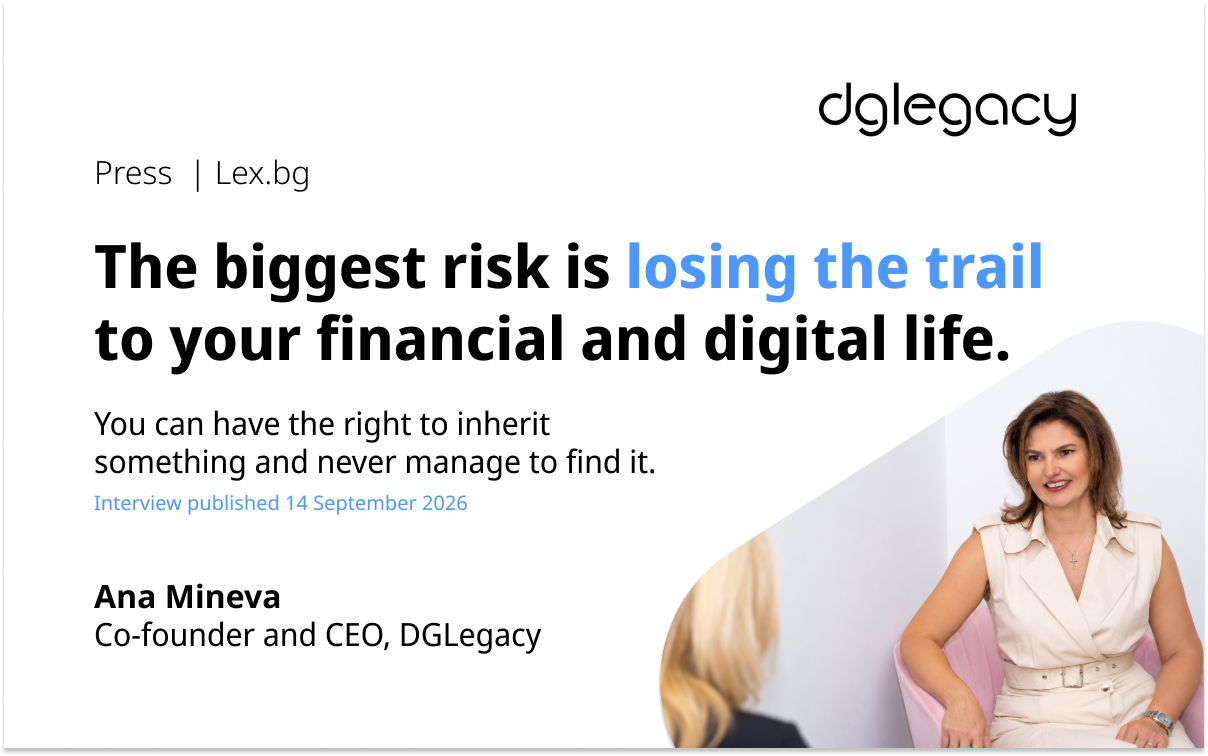
Press coverage · Lex.bg · Interview published 14 September 2026
What you need to knowIn a September 2026 interview with Lex.bg, DGLegacy CEO Ana Mineva argues that the biggest inheritance risk is sometimes not losing one asset, but losing the trail to a person’s whole financial and digital life. Legal systems differ by country, but the information problem is the same everywhere. Loved ones cannot locate, claim and access assets they do not know exist.
On 14 September 2026, Bulgarian legal portal Lex.bg published a long-form interview with DGLegacy co-founder and CEO Ana Mineva in its Faces section. The questions were asked by Silvia Rosenova.
The conversation covers why inheritance now starts with a question of existence, which digital asset people underestimate most, crypto, family memory, the law, and the role AI should and should not play. Below is an English summary prepared by the DGLegacy editorial team. Quotes are translated from Bulgarian.
From “who will inherit this?” to “will they even know it exists?”
Mineva traces the shift back more than 20 years, to the period just after the dot-com bubble, when shares and stock options were becoming a larger part of how people in technology were paid. A growing share of personal wealth was no longer something you could put in a folder or a safe.
Family property once left a physical record: notarial deeds, insurance policies, savings books. Over time, that familiar family briefcase turned into spreadsheets, online accounts, investment platforms and digital wallets.
The topic became personal while her family was living abroad and building up assets in more than one country. Even they found it hard to keep the full picture, and their children and loved ones did not really know what the family owned or where it was.
Key Insight
“Тогава въпросът се промени от „кой ще наследи това?“ в „ще знае ли изобщо, че то съществува и къде да го намери?“
“Then the question changed from ‘Who will inherit this?’ to ‘Will they even know it exists, and where to find it?’”
Ana Mineva, CEO DGLegacy®
in an interview with Lex.bg · English translation by DGLegacy
That gap, between the right to inherit and the practical ability to find the asset later, became one of the core ideas behind DGLegacy.
The most underestimated digital asset is your email
Most people expect the answer to be crypto. Mineva points instead to the personal email account and the chain of access around it. Registrations, notifications, confirmations and account recovery for banks, investment platforms, insurers, subscriptions and social networks all pass through it.
She adds the phone, because identification today often depends on two-factor or multi-factor authentication, authenticator apps, trusted devices or passkeys. If that chain breaks, a family may know an account exists and still have no practical way to recover access.
Some assets people do not even realise they have, such as insurance cover included with a credit card, a bank product or an employer package. A family may never learn it has a claim to make.
In her words, the biggest risk is sometimes not losing one specific digital asset, but losing the trail to your digital and financial life itself. And you cannot look for an asset you do not know exists.
Crypto makes the gap visible
For Mineva, crypto shows most clearly the difference between the right to inherit an asset and the real ability to receive it. With self-custody there is no bank or institution to restore access: if the private key or seed phrase is lost, the asset may remain unreachable regardless of inheritance rights. With crypto held on an exchange, the problem is different. Heirs first need to know the account exists and where it is.
Crypto, she says, simply made a bigger problem very visible: you can have a right to something and still never manage to find or reach it.
“I don’t have any assets”
It is the line she hears most often, frequently from people who in fact have bank and credit products, insurance cover, pension or investment accounts, email, cloud storage, social profiles and mobile devices.
The misconception is linking inheritance to one large, obvious value: a property, a portfolio, shares or crypto. In real life, an inheritance is far more often a puzzle of dozens of smaller things spread across different places. Each can have financial, practical or emotional value, but only if loved ones know it exists and where to look.
One information problem in every jurisdiction
Asked about differences between Bulgaria and the rest of Europe, Mineva declines to split the topic that way. Every country has its own legal tradition, culture of saving and investing, and level of digitalisation, and its laws shape what people expect to happen automatically.
What she sees everywhere is the same. Assets are increasingly spread across banks, brokers, fintech apps, crypto platforms, employers and countries, and no single national system holds the full picture. Legal regimes differ, but if loved ones do not know what exists and where it is, their right to inherit is not always enough for them to actually receive it.
Key Insight
Loved ones cannot claim what they do not know exists.
Digital inheritance is also family memory
The family album, letters and recipes used to sit in a drawer at home. They could be forgotten for years, but they still existed, and one day children or grandchildren could find them. Today their equivalent is spread across phones, cloud archives, email and social networks. If access is lost or an account disappears, part of a family’s history can disappear with it.
Our conversations, photos and emails also hold personal moments and information about other people who entrusted them to us. If we have not decided what should happen to that archive, chance decides who will see it one day and how it will be used.
Mineva also points to a legal paradox: the GDPR generally does not apply to a deceased person’s data, yet the living people whose information sits in that correspondence keep their rights over their own personal data.
For her, digital inheritance is not only about what our children will inherit. It is also a matter of personal responsibility: what family memory we leave them, how we want to be remembered, and how we treat other people’s stories that remain in our digital lives.
The law moves in parts, and that is normal
Mineva does not say legislation is failing. Law has historically followed real-life situations, and regulating something in detail before it is understood risks over-regulation and limits innovation. The law solves the problem in parts and with some delay, while digital life develops as one whole: identity, email, investments, crypto, cloud data, social networks and AI.
There are pan-European frameworks such as the GDPR, then national inheritance law, local rules and the platforms’ own terms. A platform can be in one country, the user in another and the heirs in a third.
Legal Context
European Union. Under Recital 27 of the General Data Protection Regulation, the GDPR does not apply to the personal data of deceased persons. Member States may set their own rules for processing it. Regulation (EU) 2016/679
United States. The American Bar Association notes that an executor or personal representative does not automatically gain access to all of a deceased person’s online accounts unless the deceased provided specific consent. The outcome depends on state law, the type of account and the provider’s terms of service. ABA: Digital Property FAQs
A simple test for entrepreneurs and investors
Her advice is a test: if you were out of the picture tomorrow, could the person next to you understand what you own, where it is and where to begin?
Entrepreneurs and active investors often have scattered assets: company stakes, stock options, investment and bank accounts, crypto, insurance, domains and digital accounts. She would start with an up-to-date map of what you own. It does not need to hold every sensitive detail and password. What matters is that a trail exists.
She sees a similar pattern among aspiring Gen Z investors, who experiment with far more varied instruments, from Bitcoin and meme coins to NFTs and new investment platforms. Sometimes an asset is so niche that even an experienced investor would not think to look for it there.
Key Insight
„Предприемачите сме много добри в изграждането на системи, които могат да продължат да работят без нас. Странно е колко рядко прилагаме същия принцип към собствените си активи.“
“We entrepreneurs are very good at building systems that can keep running without us. It is strange how rarely we apply the same principle to our own assets.”
Ana Mineva, CEO DGLegacy®
in an interview with Lex.bg · English translation by DGLegacy
AI can help. The decisions stay human.
Mineva says DGLegacy works with leading US business schools on real strategy and product cases. Most recently, with the University of Florida, five consulting teams independently analysed regional markets, including the US, the UK and Europe, and how AI is changing the next generation of legacy-management solutions.
Her broader conclusion is that AI will shift how we interact with technology from input to outcome. Instead of knowing what to enter, where, how to categorise it and remembering to update it, people will increasingly say what they want to achieve. For digital inheritance, that can mean less administrative effort, information that is easier to keep current, and better preparation for loved ones.
Key Insight
„AI може да помага, да организира и да предлага, но решенията какво оставяме, на кого и кога трябва да останат човешки.“
“AI can help, organise and suggest, but the decisions about what we leave, to whom and when should remain human.”
Ana Mineva, CEO DGLegacy®
in an interview with Lex.bg · English translation by DGLegacy
Trust, visibility and continuity
In ten years, she hopes people will see DGLegacy not only as a technology company but as a reliable partner for continuity between generations, recognised for three things: trust that information and intentions are protected; visibility, so loved ones know what exists and where to find it; and continuity, so that what people built over a lifetime can actually reach the next generation.
Technology is the means. The point is that the people we love should not have to start from zero one day.
Read the full interview in Bulgarian on Lex.bg.
How DGLegacy supports inheritance visibility
DGLegacy® is a secure digital legacy planning and inheritance app designed to help people catalogue their assets, designate beneficiaries and trustees, and proactively provide the designated people with the information left for them. This way DGLegacy gives transparency and awareness for your loved ones, so they can easily locate, claim and access their designated assets.
Educational. Not legal, tax or financial advice.
This article summarises a publication discussing Bulgarian and European legal context. Inheritance rules differ by jurisdiction and change over time. For advice on a specific estate, consult a qualified professional in the relevant jurisdiction.