Knowledge hub
What Is a Digital Asset?
QUICK ANSWERA digital asset is an item of value, right, record, or content that exists in digital form or is represented, accessed, or managed through digital systems.
Digital assets can include cryptocurrency, software, domain names, digital files, intellectual property, and other digitally represented assets. Some are owned and transferable; others may be licensed, contractual, personal, or governed by provider terms.
Three broad categories of digital assets
For practical purposes, digital assets can be grouped into three broad categories: digital financial assets, digital intellectual property, and digital creative assets.
These categories describe what kind of asset something is. They may overlap and should not be treated as an exhaustive legal classification.
Digital financial assets
Assets that exist or are represented digitally and can carry financial or economic value.
- Cryptocurrencies
- Stablecoins
- Tokenized securities
- Certain NFTs with economic value
- Other blockchain-based representations of value
Depending on the asset and jurisdiction, these assets may be owned, traded, transferred, sold, or inherited.
Digital intellectual property
Rights and assets created, stored, distributed, or commercially exploited in digital form.
- Software and source code
- Databases
- Proprietary algorithms and digital processes
- Copyrighted digital works
- Digital designs
The rights attached to the asset determine who owns it and whether it can be transferred.
Digital creative assets
Digital content created for personal, professional, or commercial purposes.
- Photographs and videos
- Audio recordings
- Illustrations and design files
- Presentations and manuscripts
- Digital art and online publications
Their value may be financial, intellectual, sentimental, or a combination of all three.
For inheritance planning, four groups are more useful
Digital-native assets
Traditional assets with a digital layer
Digital records and instructions
Personal digital content
3 categories = what the asset is. 4 inheritance groups = how the asset appears in the inheritance process.
A digital interface does not necessarily make the underlying asset digital-native. The distinction is whether the asset itself exists digitally or whether digital technology is mainly the way it is accessed and managed.
Are online accounts digital assets?
Sometimes, but not always.
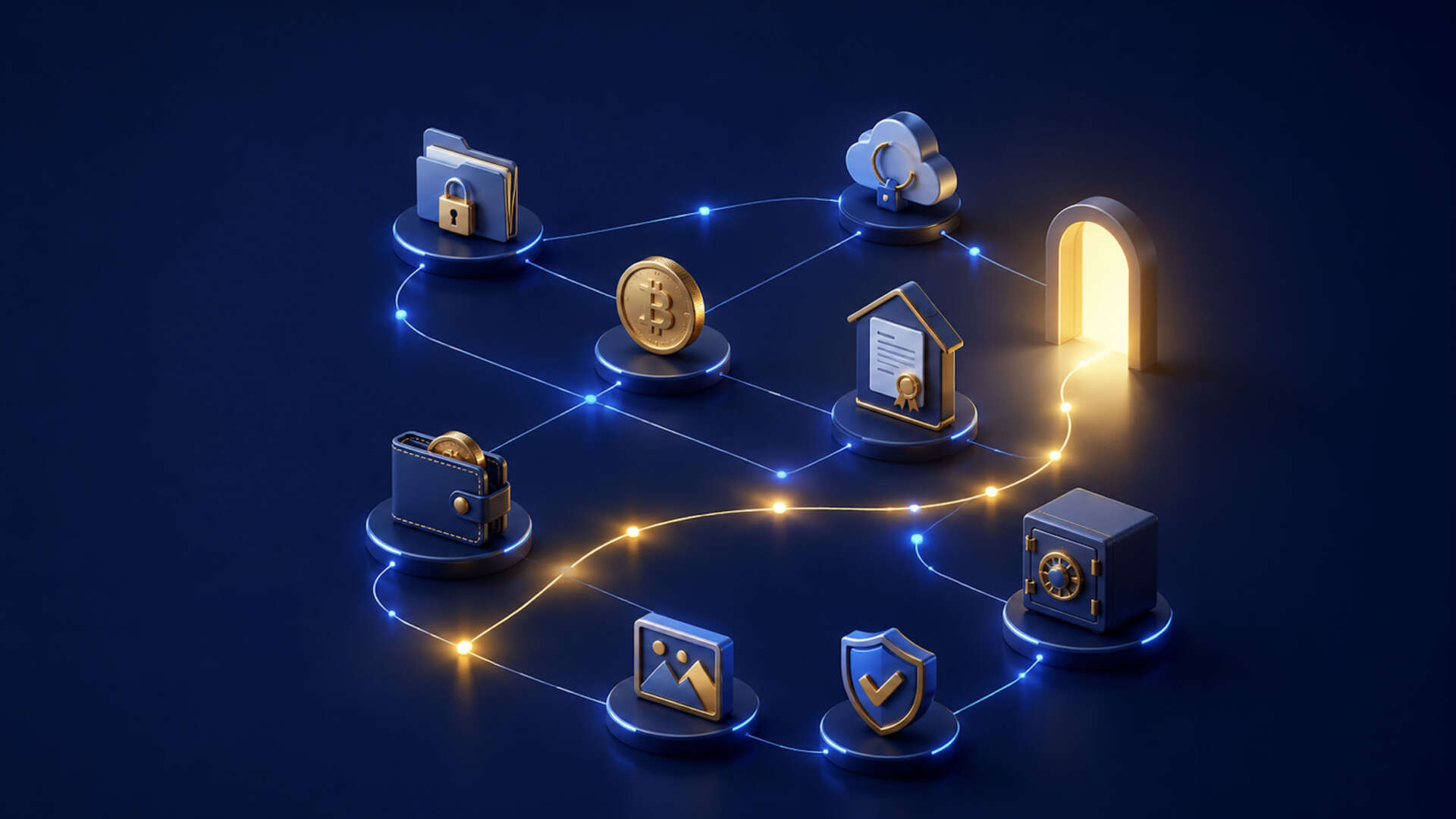
An online account can contain a digital asset, provide access to an asset, represent a contractual right, contain information about another asset, or simply act as the interface used to manage something else.
A cryptocurrency exchange account may hold digital financial assets. A cloud account may contain valuable files. A brokerage account provides access to investments. A domain registrar account may control a valuable domain.
But an email account, subscription, or social-media profile may be governed mainly by provider terms rather than conventional property ownership.
Ownership, licensing, and transferability
Digital assets are not all owned in the same way.
For example, a person may own cryptocurrency, software they created, or certain intellectual property. By contrast, access to software subscriptions, streaming libraries, cloud services, and some online accounts may be governed largely by provider terms.
Transferability therefore depends on what the person actually owns, whether the right is licensed or contractual, provider terms, intellectual-property rights, applicable law, jurisdiction, and the specific type of asset or account.
And value does not automatically mean transferability.
Are digital assets property?
Cryptocurrency, intellectual property, domain-related rights, certain business assets, and other digital holdings may carry recognizable ownership rights.
Other digital content, accounts, licenses, and services may instead be governed by contract, privacy law, intellectual-property rules, or platform-specific terms.
So rather than assuming that every digital item is property in the same way, a more useful question is: What rights does the person actually have in this particular asset or account?
Legal Context
The legal meaning of “digital asset” can differ from its broader everyday use.
For U.S. federal tax purposes, the IRS uses the term more narrowly for digital representations of value recorded on a cryptographically secured distributed ledger or similar technology, including cryptocurrency, stablecoins, and NFTs.
That tax definition should not be confused with the broader use of “digital asset” in technology, business, estate planning, and digital legacy discussions.
In the United States, laws based on RUFADAA may also affect how fiduciaries can access certain digital assets and online accounts after death or incapacity.
Source: IRS — Digital Assets · Uniform Law Commission — Revised Uniform Fiduciary Access to Digital Assets Act.
Educational. Not legal, tax or financial advice.
Ownership, inheritance rights, access procedures, taxation, and provider requirements vary by country, asset type, platform, and personal situation. Consult qualified legal, tax, financial, security, or estate planning professionals before making decisions or attempting to access assets.
Why digital assets matter for inheritance
Before an heir, executor, fiduciary, or beneficiary can act, someone usually needs to know:
- that the asset exists;
- where it is held;
- what information identifies it;
- what rights or restrictions apply;
- and where to begin.
This is especially important when asset information is spread across financial apps, cloud folders, online portals, email accounts, wallets, domain registrars, and personal devices.
Key InsightLoved ones cannot locate, claim and access assets they do not know exist.
A will, trust, or beneficiary designation can determine legal rights. But those rights can only help with an asset once someone knows it is there.
This is the gap DGLegacy® calls the Invisible Asset Problem.
For the full practical walkthrough, including asset owners, heirs, preparation, legal context, and inheritance visibility, see Digital Asset Inheritance: A Complete Guide
Frequently asked questions about digital assets
Is a digital asset the same as a digital account?
Are online accounts digital assets?
Are all digital assets transferable?
Are digital assets only cryptocurrency?
DGLegacy helps protect your digital assets and your loved ones
How does DGLegacy help protect your digital legacy?
With DGLegacy, you can easily catalog your digital assets, which enables you to protect not only them but also your loved ones should an unforeseen event happen to you.
You are able to catalog your digital, financial, and non-financial assets, designate your preferred beneficiary to them, and have them notified at the time you choose – while ensuring that your executor will know where to find your important inheritance documents.
With DGLegacy, you can protect your digital legacy. Your secure document and password manager with digital inheritance also makes it easy for you to keep your list of digital assets and beneficiaries up to date.
This way, in the event of anything unforeseen happening to you, your loved ones:
 Are aware of your digital legacy Can identify and locate all your assets Can minimize the chance of unclaimed assets.
HOW IT WORKS
Protect your loved ones quickly and easily
Set up “alive” event
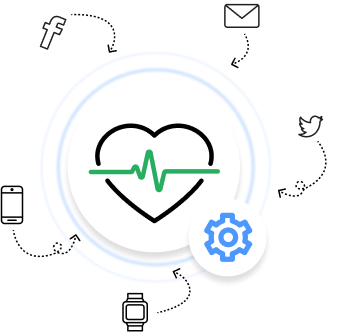
Crucial for the system's functioning, this step allows us to monitor that you are “alive”, we name it HeartBeat protocol. You have the option to adjust according to your preferences.

Catalog your assets
Catalogue the assets via DGLegacy, with minimum basic information needed, allowing your beneficiaries to identify and locate them.
Protect your assets
In case of a cyber security breach in a company which holds your assets, or media alerts for a risk related to its financial stability, DGLegacy will proactively notify you.
Invite beneficiaries and trustees
To add beneficiaries and trusties you need only their basic contact information - email and name. They will receive an invitational email.
Detection of fatal event
The Heartbeat protocol of DGLegacy, custom-engineered for your safety, confirms your well-being and detects any unexpected events. We proactively notify your beneficiaries about their designated assets in case of a tragic event.
TESTIMONIALS
What DGLegacy® users say


DGLegacy is great for protecting my assets and my family. So far I was storing my assets’ information on a google sheet shared with my wife, but I always worried that my assets will be lost if …
 Victor
Strategic Alliances Manager - dmarcian
This is a service that could make you sleep well in a time of crisis. Knowing your family is sorted out and you have every valuable under control is priceless.
 Vlad
Vlad
Senior Engineering Manager - VMware
Atlanta, Georgia, United States.
Finally a peace of mind. I always wanted a tool where I could see a snapshot of my assets, track them, and decide what to share, with whom and when.
Because my assets were stored in different systems …
 Ingrid Henke
Founder - ARRIVA relocation services
Berlin, Germany.
Knowing that DGLegacy exists is such a relief! Up till now, I’ve put my head in the sand when it came to thinking about my assets because it was so stressful with no real solution in sight. I ca…
 Alara Vural
Founder - Alara Vural Coaching
London, UK.
I have been using a secure vault and password manager for years but I always worried that my family won’t be aware of most of this information if they need it. I really like that DGLegacy combines p…
 Agnieszka Michalik
Software Architect - HERE Technologies
Berlin, Germany
DGLegacy enables me to easily track and organize all my passwords and assets.
The most important thing is that the digital inheritance capability of the service ensures that loved ones will be informe…
 Stella Schmitz
International HR Executive
CATALOGUE YOUR FIRST ASSET
Protect your loved ones when it matters the most
Join the people who are one step ahead in protecting their hard-earned money and loved ones.